I remember when I taught some of you about the conservation of the rainforests and illegal loggers actually killed some of the environmentalists as they obstruct their activities. Many were surprised that such a thing could happen. José Claudio Ribeiro da Silva, also known by his nickname of "Ze Claudio" in Brazil, a anti-logging activist was recently killed on 24 May because of his strong objection to the illegal logging carried out at the Amazon forest. Click here and here to read more. It's a very sad day for Amazon and Amazon is crying ...
Showing posts with label Natural Vegetation. Show all posts
Showing posts with label Natural Vegetation. Show all posts
Wednesday, 1 June 2011
Anti-logging activist murdered in Amazon
I remember when I taught some of you about the conservation of the rainforests and illegal loggers actually killed some of the environmentalists as they obstruct their activities. Many were surprised that such a thing could happen. José Claudio Ribeiro da Silva, also known by his nickname of "Ze Claudio" in Brazil, a anti-logging activist was recently killed on 24 May because of his strong objection to the illegal logging carried out at the Amazon forest. Click here and here to read more. It's a very sad day for Amazon and Amazon is crying ...

Saturday, 30 April 2011
Illegal logging, mining and forest fires cost Indonesia $45b

An aerial shot taken last year shows a massive oil palm plantation (left) beside shrinking natural forest cover in Central Kalimantan. Reports of the stripping of forests come even as lawmakers remain deadlocked over how to preserve them. -- PHOTO: AGENCE FRANCE-PRESSE
JAKARTA: Indonesia's Ministry of Forestry said illegal logging, land clearance, forest fires and mining have devastated Kalimantan and cost the country an estimated 311.4 trillion rupiah (S$44.5 billion).
Sunday, 6 March 2011

Monday, 28 February 2011
Rubric for 5A2 and 5A3 on Natural Vegetation
c) For a named tropical rainforest area you have studied, describe the way in which afforestation and reforestation can be encouraged.
How effective is this as a method of protecting the forest. [8]
Level 1 (0-3 marks)
Describe briefly what reafforestation is but no detail. No place reference given or very general e.g Indonesia. No supported effectiveness, or ultra simple, e.g ‘it worked’, ‘it was effective’.
Level 2 (4-6 marks)
Some description of reafforestation and how it works. Place reference given by little detail. E.g Kalimantan in Indonesia. Brief statements of effectiveness, e.g ‘ reafforestation has helped to restore some of the forest’.
Level 3 (7 – 8 marks)
Detail description of how reafforestation work.Place reference given fairly specific, e.g East Kalimantan. Clear statement of degree of effectiveness, e.g ‘in 2000, up to 90 0000 km2 of forest were replanted.’
How effective is this as a method of protecting the forest. [8]
Level 1 (0-3 marks)
Describe briefly what reafforestation is but no detail. No place reference given or very general e.g Indonesia. No supported effectiveness, or ultra simple, e.g ‘it worked’, ‘it was effective’.
Level 2 (4-6 marks)
Some description of reafforestation and how it works. Place reference given by little detail. E.g Kalimantan in Indonesia. Brief statements of effectiveness, e.g ‘ reafforestation has helped to restore some of the forest’.
Level 3 (7 – 8 marks)
Detail description of how reafforestation work.Place reference given fairly specific, e.g East Kalimantan. Clear statement of degree of effectiveness, e.g ‘in 2000, up to 90 0000 km2 of forest were replanted.’
Saturday, 5 June 2010
Why the global struggle against deforestation matters, and how you can help

This 2005 photograph shows a deforested region of the Amazon rainforest in Brazil. The country is targeting an 80 per cent reduction of forest clearing by 2020, and has also begun replanting deforested areas of the Amazon with palm trees. -- PHOTO: AGENCE FRANCE-PRESSE
What is deforestation?
Why does it happen?
How bad is it?
Where are the most forested areas?
Why is it important to keep forests?
What is being done to control deforestation?
But what about the rich countries?
What is the rate of progress now?
What can you do?
Wednesday, 12 May 2010
Saving Tekong's coastal greenery

NParks' pilot project to stem erosion of mangroves by waves from passing vessels
By Grace Chua
May 12, 2010
THE north-east coast of Pulau Tekong is being swept away by the sea, and taking a stretch of pristine mangroves with it.
To stem the erosion, the National Parks Board (NParks) is planting more mangroves in a pilot project on the military island off Singapore's east coast. And if it succeeds, the same methods could be used in other threatened coastal areas here.
The 92ha, 3km-long stretch of mangrove swamp is home to rare birds and mangrove trees. But strong waves from passing vessels have scooped out chunks of the coast to form horizontal berms (see graphic) held in place only by the mangrove roots. In 2006, NParks found that a number of trees had fallen along a 1.65km stretch of coastline. Another 1,300 were in danger of toppling.
It began collecting data on the site, and in February last year started work on modelling the area's wave movements and investigating the soil.
With development consultants Surbana, NParks designed a set-up of mud-filled bags, rocks, mangrove seedlings and poles to not only replace lost mangroves but also stop repeat erosion. NParks also plans to plant certain hardier species of mangroves farther out to sea to stymie the waves.
In their assessment, environmental consultants DHI assured that the project would not cause the coastline to creep outwards towards international boundaries, and there would be no cross-border physical or ecological impact. The site is just 760m from the Singapore-Malaysia boundary.
Construction is expected to begin in the middle of this year and take about 12 months. The same methods may one day be applied to other eroded areas like Sungei Buloh near Kranji.
'We hope this will be a good test-bedding site, though conditions might be different at different areas. But this is a good model for areas that have mangroves and are eroded,' said NParks' National Biodiversity Centre deputy director Lena Chan.
Even though the Tekong mangrove area is off-limits to the public, it remains an important part of Singapore's natural heritage and a source of genetic diversity, reminded Dr Chan.
National Institute of Education plant biochemist and mangrove expert Jean Yong said it was important to plant multiple tree species on such engineered structures to boost biodiversity.
The public can view the project's environmental impact assessment report till next month - by appointment with NParks - when a tender for the project will be put up.
caiwj@sph.com.sg
Wednesday, 14 April 2010
Mangroves may vanish in 100 years
ST, Apr 14, 2010
World's mangrove species are threatened by rising sea levels and coastal developments

Bruguiera hainesii or berus mata buaya is one of the two rarest mangrove species in the world, with just two plants left in Singapore. -- PHOTO: JEAN YONG
MANGROVE expert Jean Yong was strolling with his wife along Pasir Ris beach in 2003 when he chanced upon a delightful find.
The National Institute of Education plant physiologist had spotted a mangrove plant he could not identify.
The mystery mangrove turned out to be a Bruguiera hainesii or berus mata buaya (crocodile eye in Malay and named for the big knob-like protrusions on its tree trunks), one of the two rarest mangrove species in the world, with just two plants left in Singapore. The other is at Pulau Ubin.
The other rare species is the Sonneratia griffithii found in India and South-east Asia. It has not been found in Singapore.
There are fewer than 90 adult Bruguiera hainesii trees left worldwide: four in Vietnam and some 80 in Malaysia, and conservation organisation the International Union for Conservation of Nature (IUCN) considers them 'critically endangered'.
And it gets worse: The world's 70 species of mangroves, which are located along coastlines, may be set to get rarer, as they are threatened by sea-level rise and coastal developments. They are also being cleared for aquaculture such as prawn farms.
Effectively, mangrove forests may disappear in just 100 years. That is what Assistant Professor Yong and 20 other mangrove experts and IUCN scientists have warned about, in a report published last week in international biology journal PLoS ONE.
'Mangroves are at the worst place in the world - the transition between coastal and marine habitats, which face the most pressure,' Asst Prof Yong said.
By expert estimates, these tidal wetland ecosystems provide at least US$1.6 billion (S$2.2 billion) worth of services a year, such as protecting coastlines from erosion, improving water quality and providing habitats for commercial fish species.
Here, they can buffer the coastline from waves more effectively than concrete berms, and are home to snails, mudskippers, crabs and the birds that feed on these swamp-dwellers.
Singapore has about 500ha to 600ha of mangrove area, mainly at Sungei Buloh and Pulau Ubin, and with pockets at Labrador Park, Pasir Ris and other areas.
That figure is on the rise as conservation projects take root, but it is still a tiny fraction of the 6,400ha of mangroves the country had in 1953.
There are 36 species of 'true' mangroves (trees which usually grow only in tidal habitats) here, or just over half of all known species.
And what of the very rare Bruguiera hainesii trees here? The National Parks Board (NParks) is monitoring the health of Singapore's two specimens and its staff prune weeds around them to let sunlight through.
NParks' care is not limited to the rarest mangroves - it collects and cultivates young plants of 10 or so rare species, which are then replanted in national parks and reserves, explained Dr Lena Chan, deputy director of NParks' National Biodiversity Centre.
It will take time to see results, however.
Bruguiera hainesii are the 'slow giants' of the mangrove world, Asst Prof Yong said.
They grow up to 33m and may live as long as 300 years, but the seedlings grow less than 30cm a year.
So while reforestation of mangrove areas is an option, the paper's authors write, it is usually successful only when large numbers of fast-growing species are planted - other rare and slow-growing species cannot be replanted easily.
'Mangrove areas may be able to be rehabilitated in some regions, but species and ecosystems cannot be effectively restored.'
Tuesday, 13 April 2010

Friday, 5 March 2010
Have a Heart, save the rainforest

The expansion of oil palm plantations in Indonesia (above) and Malaysia has led to deforestation, which has an impact on wildlife and fresh-water supply, as well as contributes to carbon emissions. -- ST FILE PHOTO
The head of the World Wide Fund for Nature's (WWF's) Heart of Borneo rainforest conservation initiative, Mr Adam Tomasek, was in Singapore recently to speak about the programme. The WWF is working with Indonesia, Malaysia and Brunei to protect 220,000sq km of highland rainforest on the island of Borneo which is rich in species diversity. Mr Tomasek, 37, speaks to Grace Chua on the scheme's progress three years after the 2007 declaration was signed.
Three-nation pact shelters Borneo's ecosystem from logging, development
What were the issues facing the Heart of Borneo initiative?
It really comes down to economic development. Palm oil was a relatively new industry just 20 years ago and the impact of converting forests to oil palm plantations was not very well known.
As companies expanded in Indonesia and Malaysia, we started to see some of the impact and realities in higher rates of deforestation.
That is a combination of the timber industry rising and plateauing, and the palm oil industry on the upswing.
In those countries, over 80per cent, almost 85per cent, of the carbon emissions comes from deforestation and land use conversion... not urban development, not coal-fired power plants... It is keeping forests or turning them into something else.
What has the initiative achieved in the three years since the pact was signed?
There are a number of examples. One of them is that the Sabah state government has implemented a no-logging policy on more than 200,000ha of land.
This area has the highest density of orang utan in Malaysia.
They have also removed proposals to have more oil palm plantations.
There are real conservation outcomes - about 5,000 to 6,000 orang utan live in this part of Sabah, and they have a safe home.
And a one-million-ha forest corridor that will connect the four main national parks in Borneo is being planned, allowing species to roam around.
How did you get Indonesia, Malaysia and Brunei to put aside their differences and cooperate?
In that long negotiating process, they agreed that they all shared the island. Borneo is still draped in these wonderful tropical rainforests, and there is a lot of pride in that.
But it is not just about forests. It is about the other things that come along with having a healthy forest ecosystem. One example is fresh water.
All the major cities, all the economic developments in the lowlands are completely dependent on water that comes from the highest parts of Borneo. And some watersheds are transboundary, so there is an interdependency.
In 2006, Brunei Shell - which runs the oil and gas refineries along the Brunei coast - came to the conclusion that if it were to lose the upstream fresh-water sources that it had not valued economically, in no more than 48 hours, the industrial energy and natural gas plants would be shut down.
Then all of a sudden you had a business voice on the table.
What challenges remain?
They are related to economic development. For instance, the Sarawak government started a statewide renewable energy drive to generate hydroelectric power and maybe export electricity, but that will affect watersheds.
So we have to ensure that the commitments around the Heart of Borneo are really embedded in these economic growth decisions.
What does the initiative mean for Singapore?
The Heart of Borneo is part of the regional heritage and Singaporeans can take pride that this is one of the few places in the world where you get orang utan, pygmy elephants and rhinoceroses living together.
In Singapore, citizens have a voice and they have a choice.
Palm oil is in almost every choice - food, cosmetics and so on. Being aware of good choices is a really big step.
There are very strong Singaporean business links to palm oil - such as holding, parent or investment companies - and there are very strong linkages to a lot of big industrial sectors.
We have been trying to engage them in a regional context.
But it is slow work. Agricultural product suppliers Olam and Wilmar or Asia Pulp and Paper have a lot of different business interests.
Part of it is figuring out what is in their best interests and where the liabilities and risks are.
(We are trying to) bring together a kind of green business network that would cut across the different sectors.
What do you think you can do to support the movement of 'Save the Forest'? You can post your thoughts under comments.
Wednesday, 21 October 2009
Keep marine ecosystems afloat: UN
Report says such 'blue carbon sinks' help mitigate climate change
 Experts warn that if no action is taken to protect coastal ecosystems - like this mangrove sanctuary in Thailand - species, livelihoods and blue carbon sinks will be lost within decades. -- PHOTO: REUTERS
OCEANS, like forests, play a critical role in absorbing carbon dioxide to keep global warming at bay, and a new report has called for the preservation of marine ecosystems to offset climate change.
The Blue Carbon report, launched on Thursday by the United Nations, has found that up to a third of marine organisms such as mangroves, salt marsh plants and seagrasses that thrive in shallow coastal waters off India, and parts of South-east Asia and the Caribbean, have been lost since the 1940s.
'If more action is not taken to sustain these vital ecosystems, most may be lost within decades,' it noted.
Not only will species and livelihoods be lost, but a vital 'blue carbon sink' as well, said experts.
According to the UN report, marine ecosystems store up to 1.6 billion tonnes of carbon dioxide every year - roughly equivalent to half the yearly emissions of the entire global transport sector.
Much of the degradation has been caused by unsustainable fish farming practices, inadequate coastal development and waste management.
'We know that land use change is part of the climate change challenge,' said Dr Carlos Duarte, one of the report's chief scientists, who is from the Mediterranean Institute of Advanced Studies in Spain.
'Perhaps less well known is that the global loss of what we could call our 'blue carbon sinks', are actually among the key components of the increase in greenhouse gas concentrations from all land use changes,' he pointed out.
The loss of such coastal ecosystems also has an economic impact as they supply half the world's demand for fish and protect against coastal erosion and tsunamis.
Coastal systems have an estimated economic worth of US$25 trillion (S$34.8 trillion) annually.
Policymakers converging in Copenhagen for the world climate summit in December are likely to agree on a plan to preserve forests in developing countries as part of a wider agreement aimed at cutting carbon emissions, said Mr Achim Steiner, executive director of the UN Environment Programme.
The role of other ecosystems should not be overlooked, he stressed.
'If the world is to decisively deal with climate change, every source of emissions and every option for reducing these should be scientifically evaluated and brought to the international community's attention.'
The report noted that curbing deforestation on land together with a restoration of marine ecosystems could reduce up to 25 per cent of the carbon emissions to keep concentrations of carbon dioxide in the atmosphere below 450 parts per million.
This was a benchmark identified in the 2007 report by the Inter-governmental Panel on Climate Change to keep global warming below 2 deg C, to avoid the dangerous effects of climate change like severe weather patterns.
Preventing the further loss of coastal ecosystems alone can contribute to at least 10 per cent of the emission cuts needed.
Mr Patricio Bernal, assistant director-general of the UN Educational, Scientific and Cultural Organisation, said: 'Because the ocean has already absorbed 82 per cent of the total additional energy accumulated due to global warming, it is fair to say that the ocean has already spared us from dangerous climate change.
'But each day we are dumping 25 million tonnes of carbon into the ocean, turning it more acidic and hence posing a huge threat to organisms.'
Sunday, 7 June 2009
Tables 1A and 1B for Question 13 (b)

These are the missing tables for the question on natural vegetation 13 (b). Thanks to Kieroy and Jorge for alerting me if not I didn't know I didn't print the tables for you. Here they are, no excuse for not doing work. ;-)
Friday, 29 May 2009
Figures for Natural Vegetation Holiday Assignment
Dear 5N1 & 5N2,
Use the following figures for Question 13 (b)of your 'Natural Vegetation' holiday assignment. The pictures should be in colour. I can't find the original photographs, so I'm replacing them with the photographs below.
Photograph A,
showing characterisitics of tropical rainforest
showing characterisitics of tropical rainforest

Photograph B,
showing characterisitcs of coniferous forest
showing characterisitcs of coniferous forest

Wednesday, 30 January 2008
Tsunami: Mangroves 'saved lives'
Dear Sec 3 pupils,
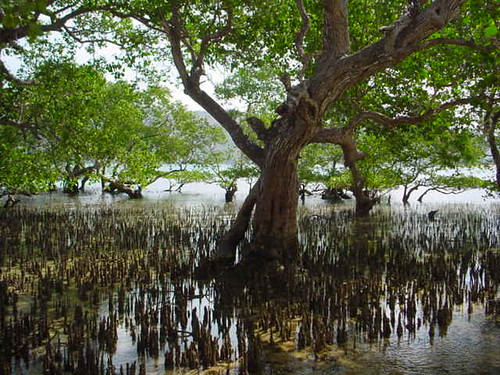
As this week we're studying natural vegetation, I thought I'll put these articles for your reading pleasure. This article is about the importance of Mangroves. It's an interesting read. It helps you understand why we need to protect our mangrove forests because they can saves lives. The detail article can be found here.
Another similar article about how mangroves offers protection can be found here. I'll put a short excerpt for you.
"Ecologists tell us that mangroves provide double protection – the first layer of red mangroves with their flexible branches and tangled roots hanging in the coastal waters absorb the first shock waves. The second layer of tall black mangroves than operates like a wall withstanding much of the sea’s fury. Mangroves in addition absorb more carbon dioxide per unit area than ocean phytoplankton, a critical factor in global warming."
"If only the mangroves were intact, the damage from tsunami would have been greatly minimized. It happened earlier in Bangladesh. In 1960, a tsunami wave hit the coast in an area where mangroves were intact. There was not a single human loss. These mangroves were subsequently cut down and replaced with shrimp farms. In 1991, thousands of people were killed when a tsunami of the same magnitude hit the same region. In Tamilnadu, in south India, Pichavaram and Muthupet with dense mangroves suffered low human casualties and less economic damage from the Dec.26 tsunami. Earlier, the famed mangroves of Bhiterkanika in Orissa (which also serve as the breeding ground for the olive-ridley turtles) had reduced the impact of the ‘super cyclone’ that had struck in Oct 1999, killing over 10,000 people and rendering millions homeless."
Subscribe to:
Posts (Atom)